
Japan has a political party called Team Mirai that turns citizens’ conversations with AI into law. A citizen tells the party about a problem via an AI chatbot. AI asks follow-up questions and drafts a policy proposal. If enough citizens back the idea, it becomes an official proposal that the party’s lawmakers might submit to the national legislature.
Engineer and novelist Takahiro Anno founded the party in 2025. It won a seat in Japan’s upper house that July, followed by eleven seats in the lower house in February 2026 on almost 7% of the vote. Many of its bills are small and uncontroversial, such as extending HPV vaccination to men or better school support for kids with learning disabilities.
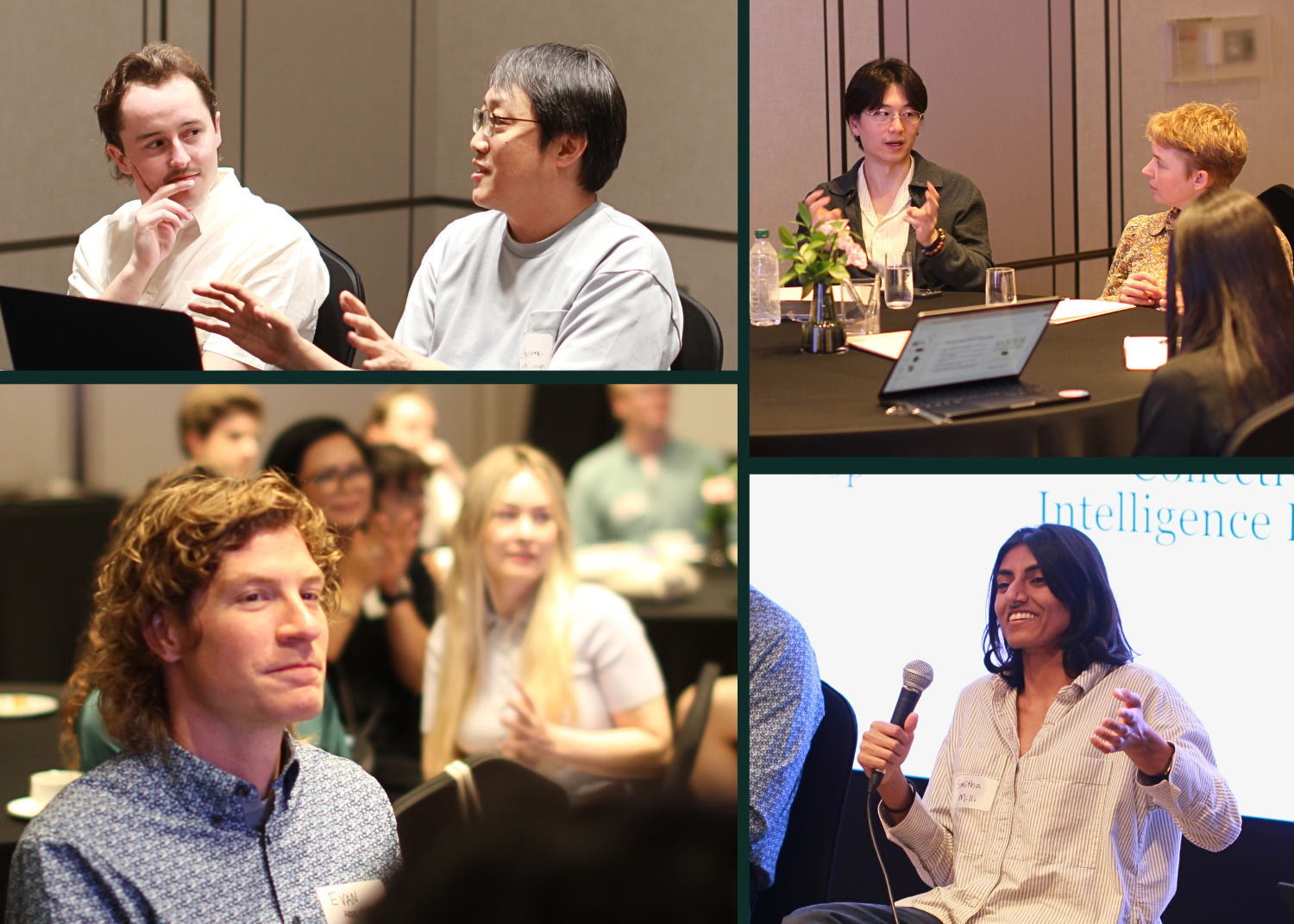
Across the world, people are testing and building tools to support citizens, decision-making, and cooperation. Roughly fifty gathered in Seoul, including also AI researchers and developers building deliberation and cooperation tools, researchers focused on power concentration and gradual disempowerment, democracy practitioners working on the front lines of institutional resilience, and researchers from frontier AI labs.
Some highlights from two more teams improving debate and deliberation processes:
Participants generally agreed that the most effective uses of AI in decision-making appear to be narrow: supporting humans in making decisions, rather than AI making decisions. AI appears to excel at assisting citizens in translating their views into policy analysis and clarifying debate and discourse.
Six points participants returned to across the talks and breakout sessions:
AI cannot change the broader status quo incentives around contentious political questions. Participants noted that AI’s usefulness narrows on topics where people want opposing things. Team Mirai takes no position on divisive issues and puts them to a direct vote instead, not acting unless there is consensus.
Requiring participants to verify AI-drafted submissions can mitigate AI bias. Team Mirai only receives the AI’s summary if the citizen confirms it matches their own experience. Ownership of what gets submitted stays with the citizen, who is the final approver.
AI may help citizen assemblies more by strengthening citizens’ deliberative muscles than by scaling participation. Citizen assemblies empower a small number of randomly selected citizens to deliberate on a specific policy issue. They work, participants heard, because people reflect, listen, and change their minds. In this view AI helps most when it improves that process, not when it simulates a larger crowd.
AI moderators can elicit nuanced interviews at scale. One project reported using an AI moderator to interview 81,000 people worldwide, with the AI able to follow up on what participants raised rather than sticking to fixed survey questions. Others cautioned that this gives the AI meaningful power over the output, since it decides what to ask, what to keep in memory, and how to convey what was said.
Survey evidence cited in the room suggested people trust AI more than their political and religious leaders, but do not trust AI companies. AI appears to give balanced and empathetic advice. Big tech companies themselves are not trusted to make societal decisions. Some participants read this as an opening for bridge-building tools along the lines of Community Notes.
Much of the AI and democracy space is under the radar. Discussion tends to centre on Pol.is, Community Notes, or large proposals for global democracy, while smaller efforts run without much attention.
At the end, the group ran a Pol.is poll on itself. 57 participants cast 1,165 votes on 33 statements. The statement participants most disagreed with was a prediction that by 2036, humans will be better off handing decision-making to AI agents because people don’t know what they want.
The statement with the widest agreement was that most current AI cooperation tools will fail once they meet real political incentives.
Real political incentives was the main focus of David Duvenaud, a co-author of ‘Gradual Disempowerment’ which proposes that as AI gets better at running things, institutions like companies, markets, and governments will feel pressure to remove humans from the loop. A government that answers to its citizens falls behind one that prioritises growth.
A representative of the Cooperative AI Foundation asked Duvenaud: ‘every Malthusian prediction in history has been wrong. Malthus expected the population to outrun the food supply, but the invention of synthetic fertiliser instead allowed the population to multiply. Why is this time different?’
Duvenaud is not completely resigned. He puts the odds that things go well at about one in five. The solution, he says, is bigger than making one model behave. The goal is aligning civilisation itself.
Aligning civilisation is an abstract goal, in part because of the vast number of social and political systems within each country.
Lewis Hammond of the Cooperative AI Foundation and Beatrice Erkers of the Foresight Institute closed the day noting that pockets of people are already working on these questions. Individuals or organisations who want to join them, or who need connections or funding to get started, should get in touch.
To further engage with the field, we also recommend:
August 21, 2026
.png)


