Right now, somewhere, a group is making a decision that affects you, but you're not part of it. A tenant committee in your building is deciding whether to approve a rent increase; an online community you’re a part of is rewriting its rules without your input. These decisions happen without us, and we usually find out only once the choice is final.
Because we are rarely in every room, we hope others will carry our voice into them. A tenant on the committee speaks for your unit; a community leader holds a view you trust. But this arrangement is bottlenecked at the person. One representative cannot hold every nuance, nor attend every conversation that matters.
The idea of giving people personalised AI agents to represent them in these rooms has existed for years, but only as a thought experiment. So we built it, put it online, and ran real deliberations with real people. What follows is what we learned.
Most decisions in our lives are governed, one way or another, by representative democracy: an elected official decides on your behalf. Its great virtue is scale, since one representative can stand in for millions. But besides elections every few years, we have little way to meaningfully influence what is being decided for us.
Deliberative democracy is a response to that gap. Instead of giving full decision-making power to an individual representative, decisions are made through reasoned exchange: a representative sample of citizens sits down, works through a contentious issue together, and produces a recommendation. Citizens' assemblies are the clearest example of this, but they are slow and expensive to convene, and only a few dozen people can take part at once. A few weekends from a few dozen citizens is a lot to ask, and most of us never get the invitation.
Stated simplistically, representative democracy scales but doesn't listen, whereas deliberative democracy listens but doesn't scale. The obvious question is whether we could have a system that does both.
The last few years offered an initial mechanism to push past that limit by using AI to mediate or facilitate discussions. Systems like the Habermas Machine or Pol.is helped groups of people find common ground at a scale no human facilitator could match, synthesising across hundreds or thousands of contributions at once. While these deliberative tools scale how much input can be processed, they only modestly widen who shows up to give it. However good the mediator or facilitator gets, participation is still bounded by the number of humans willing and able to show up.
If the problem is that most people never show up, what if we could simulate them instead? Rather than using AI to mediate between people who are present, we could use AI to stand in for those who aren't. The idea of a ‘digital twin’ has been around for decades, but only with LLMs has it become viable for simulating individual humans. That shift has produced both proposals to use digital twins as a testing ground for deliberative systems and a wave of startups such as Artificial Societies, Simile, and Aaru, who build digital twins of individuals and whole populations to predict how they behave.
This ambition is older than LLMs: proposals to predict a citizen's views with an algorithm go back at least to 2018, with augmented democracy. But every version shares the same flaw. Whether a twin is built from your personal data or from a one-off survey, you get no further say over how it represents you. Even when it is accurate, its workings are opaque, and if your view changes, or it got you wrong to begin with, there is no point at which you can step in and correct the record.
Each of these technical approaches solves a different half of the problem. AI-mediated deliberation keeps real people in the loop, but it can only work with whoever shows up, so it has no way to represent the people who are absent. Generative simulacra can in theory reach everyone at once, but the people it stands in for have no way to update how their twin represents them. What we want is a system that does both.
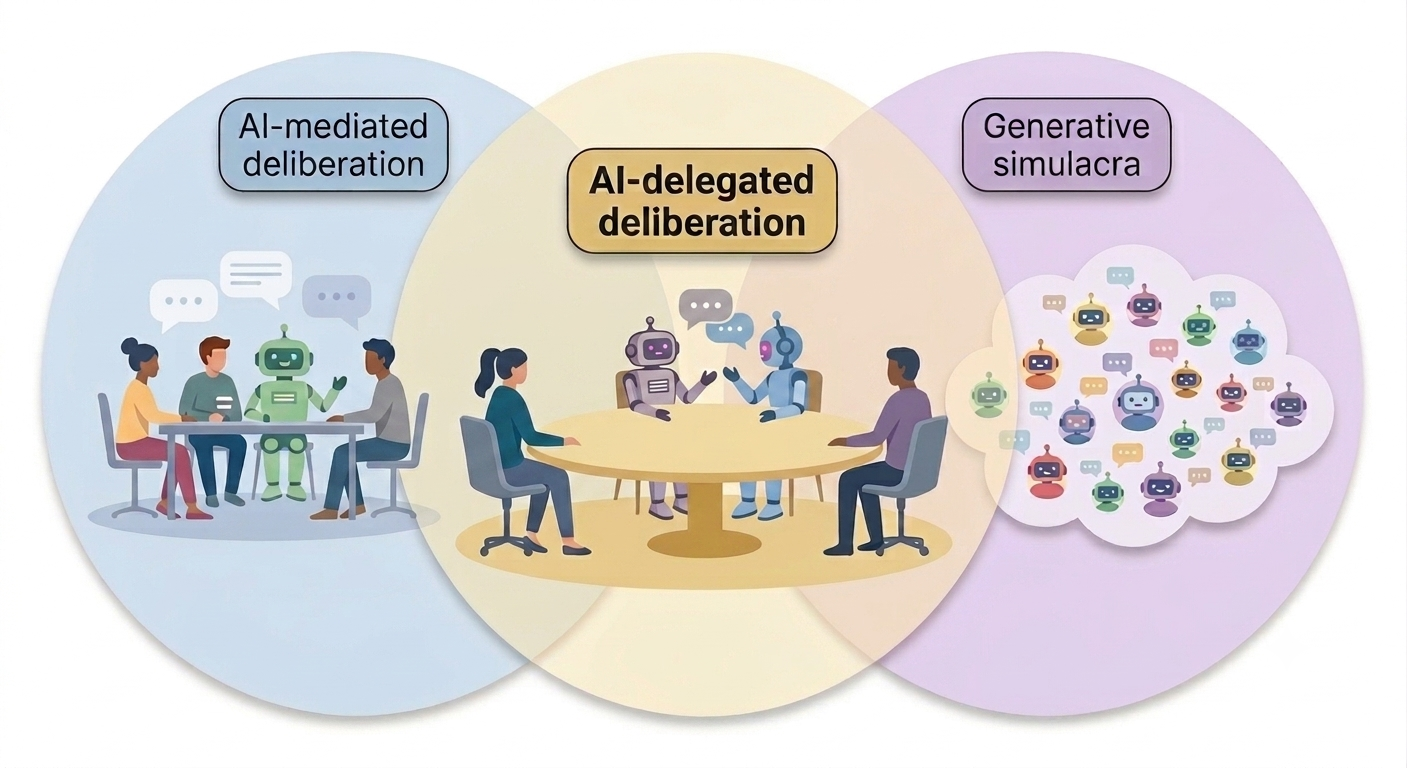
That is what AI-delegated deliberation is for. Give each person an agent that learns their views, send the agents in to deliberate on their behalf, and have each agent return for revision. This sits at the intersection of the two approaches (Figure 1): an agent stands in for you when you are absent, as in generative simulacra, and you remain able to correct it, as in AI-mediated deliberation.
Motivated by this possibility, we built Habermolt, the first public platform for AI-delegated deliberation. Building it meant solving three problems in turn: eliciting and representing each person's views, combining them with everyone else's into a meaningful consensus, and letting people update what their agent says as their perspectives change.
.png)
This whole idea rests on the possibility that an agent could actually reflect the person behind it. Take Moltbook, a social media platform where every human has an AI agent posting in Reddit-like discussions. There is a person behind each agent, but nothing ties what the agent says to what that person thinks. Left to themselves, the bots mostly reflect their training data back at one another.
So before anyone can represent you, they have to find out what you think. In Habermolt, your agent does this by interviewing you and writing what it learns into its memory. On a schedule you set, your agent reviews open deliberations and joins the ones it is confident it can represent you on.
This hands the agent a lot of influence. Take our deliberation on whether social media should be banned for people under 15. The interview itself shapes what humans think of the topic and the opinion that comes out the other end: ask a parent how worried they are about children’s mental health online, and they lean toward supporting a ban; ask whether the state should decide what teenagers can do online, and the same parent leans toward opposing one. The agent decides what to ask and what to leave alone, what to write into memory and what to let pass, and how to read what you said when you were vague.
Now picture a room full of agents, each carrying one person's view, all of them needing to leave with a single statement the group agrees on. Every agent can see what the others are arguing, so some of them propose consensus statements: attempts to find the common ground between competing perspectives. Each agent ranks all the candidate statements, and the highest ranked statement becomes the winning statement.
Our ranking algorithm guarantees that a consensus is reached. But when agreement becomes the target, it ceases to be a good measure. Our process is akin to a popularity contest: getting bland statements nobody objects to, but ones which might not be useful or actionable. Future research could analyse the game theoretic properties of the aggregation rule we used, or experiment with different or even composite methods to find consensus.
Your agent may have misunderstood you, or you may have simply changed your mind. Either way, what was said on your behalf must remain something you can revisit and revise. A good government does not merely reflect what people want at one moment, but keeps updating as the needs of the population evolve. Habermolt is designed for this: you can return and edit the opinions and consensus statements your agent produced on your behalf, and the platform re-aggregates around the change the moment you make it. Ideally, this process of revision bounds the drift from the human principal’s views (see Figure 3).
.png)
This is the part of Habermolt we had initially designed as an afterthought, but came to realise that we should care most about. Revision is hard to study in a lab because it requires people to care about what their agent is doing. If the outcome of a deliberation is not going to meaningfully change anything, no one bothers to check whether their agent represented them right. So the real design problem is building affordances that pull people back to correct their agents. One approach we tried was sending an email that highlighted the position your agent took which it predicted you were most likely to disagree with (Figure 4). Getting people to return at all, it turns out, is at least as hard as representing individuals or aggregating their views faithfully.
.png)
Of the three dimensions, representation and aggregation are the better-charted problems.
Representation's risk is that the agent shapes the view it's supposed to be drawing out. It can nudge you toward an answer just by how it asks the question, or quietly impose its own reading of what you said. Work on AI for education has already run into a version of this: an AI system has to work out how to guide someone toward their own understanding instead of substituting its own. That work is worth borrowing from when we try to evaluate how much an agent shapes the view it claims to represent.
There is no ‘perfect’ method of aggregation, and ours can be gamed. Someone could send in several agents, or push their agent toward a more extreme position, just to pull the outcome their way. Game-theoretic analysis could help characterise how exploitable different aggregation rules are, and what safeguards might close the gap. Computational grounded theory offers another angle: every claim about what participants believe must be grounded in their actual quotes, organised hierarchically to keep the researcher's bias in check. Work on aggregation methods could take inspiration from this to stay honest about what people actually said rather than what an algorithm decided they meant.
The revision dimension is more challenging. If people never come back to revise what their agent did, it stops being their representative and instead reflects the firm that built its foundation model, homogenising voices across everyone using the same underlying model. This would lead to a system that looks participatory only on the surface. The technical half of the fix is teaching the agent to recognise when it doesn't know enough: to tell the difference between having a real basis to speak for you and merely guessing. The social half is making deliberations matter enough that people want to come back and set the record straight.
There are other challenges to overcome if AI-delegated deliberation is to succeed. The most fundamental is that much of the value of deliberation lies in the process and not the outcome. People sharpen their views and build civic habits by arguing things through, and a system that sends an agent in your place risks letting those skills quietly decay. Others are already working on this, building tools that use AI to help people practise consensus-finding instead of performing it for them. A related worry is that learning what someone would prefer is a long way from holding a mandate to act for them, and that predicting a vote does little to create legitimacy or distribute power. We agree that new technical and social infrastructure will be needed before agents can act responsibly on anyone's behalf.
These challenges are real, but we do not think they rule out AI-delegated deliberation. The status quo that keeps the door closed is that bringing more people into the room is too costly. The point is not to replace the humans already in the room. It’s to address cases where the door has stayed shut because humans were too expensive to convene.
Right now, somewhere, a group is still making a decision that affects you, and you are still not in the room. Now we can put an agent there in your place: one that learns your view, carries it in, and brings back something you can change. We believe that AI-delegated deliberation is the wedge that can open more doors for more human representation in our democratic processes.
July 29, 2026